1.1. The Science: Why We Must Close the “Tight Junctions”
Welcome to Day 3. Following the detox of Day 1 and the anti-inflammatory shield of Day 2, today is dedicated to Structural Reconstruction. The root cause of chronic fatigue, brain fog, and autoimmune reactions often lies in “Leaky Gut Syndrome” (Intestinal Permeability). The intestinal wall is lined with a single layer of cells held together by Tight Junctions. When these junctions loosen due to stress or inflammatory foods, toxins (LPS) leak into the bloodstream. To repair this, we must inhibit Zonulin (the protein that opens these gates) and supply the raw materials for rebuilding: Zinc and Glutamine. Furthermore, we must strictly avoid Advanced Glycation End-products (AGEs), which cause cross-linking and stiffness in tissues.
1.2. Morning Routine: Preparing the Mucosa
- Warm Water + Pink Salt: Maintains osmotic balance in the mucosal lining.
- Extra Virgin Olive Oil (1/2 Shot): Lubricates the digestive tract and stimulates bile flow to remove endotoxins.
- 2 Boiled Eggs: Provides Glutamine precursors. Glutamine is the primary fuel source for enterocytes (intestinal cells). Without it, the gut cannot repair itself.
1.3. Lunch: The Power of “Paraprobiotics” (Heat-Killed Bacteria)
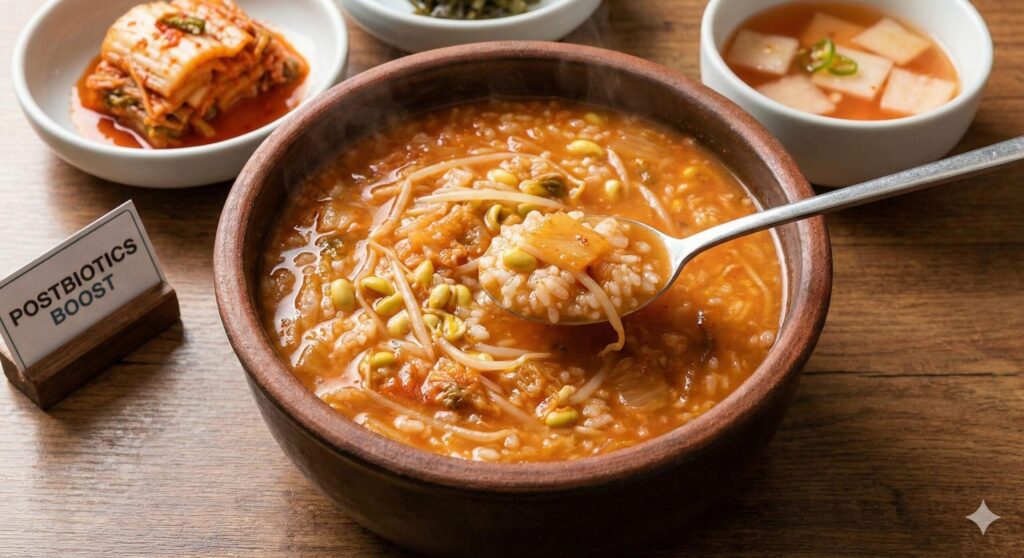
- Menu: Kimchi Bean Sprout Porridge (Recipe Link)
- The Logic (Beyond Probiotics): There is a misconception that probiotics must be alive to be effective. A pivotal study in Frontiers in Immunology (2020) highlighted the efficacy of “Paraprobiotics” (heat-killed probiotics).
- Peptidoglycans: When Kimchi is cooked, the bacteria die, but their cell wall components (peptidoglycans) remain intact. These particles bind to receptors in the gut (TLRs), stimulating the immune system without the risk of bloating or bacterial overgrowth (SIBO) that live bacteria might cause in a compromised gut.
- Aspartic Acid: The bean sprouts provide aspartic acid, which accelerates the urea cycle in the liver, effectively removing ammonia and fatigue toxins.
1.4. Snack: Prebiotic Intervention
- Menu: Grain-Free Biohacking Granola (Recipe Link)
- The Logic: To prevent Zonulin release, we avoid gluten. Instead, we use nuts and seeds rich in fermentable fibers. These act as Prebiotics, feeding beneficial bacteria like Akkermansia muciniphila, which strengthen the gut barrier.
1.5. Dinner: The “Zinc” Protocol & Avoiding the Maillard Reaction
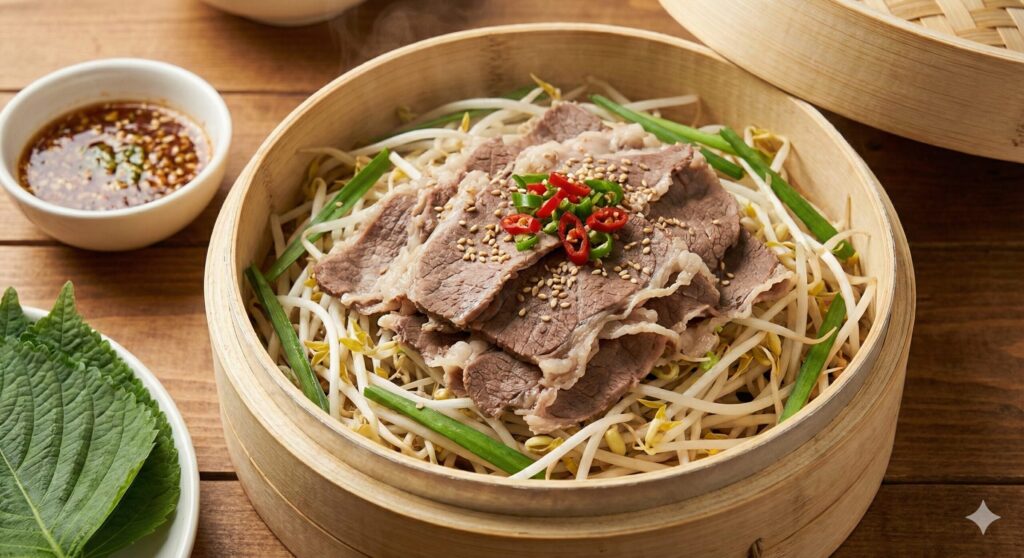
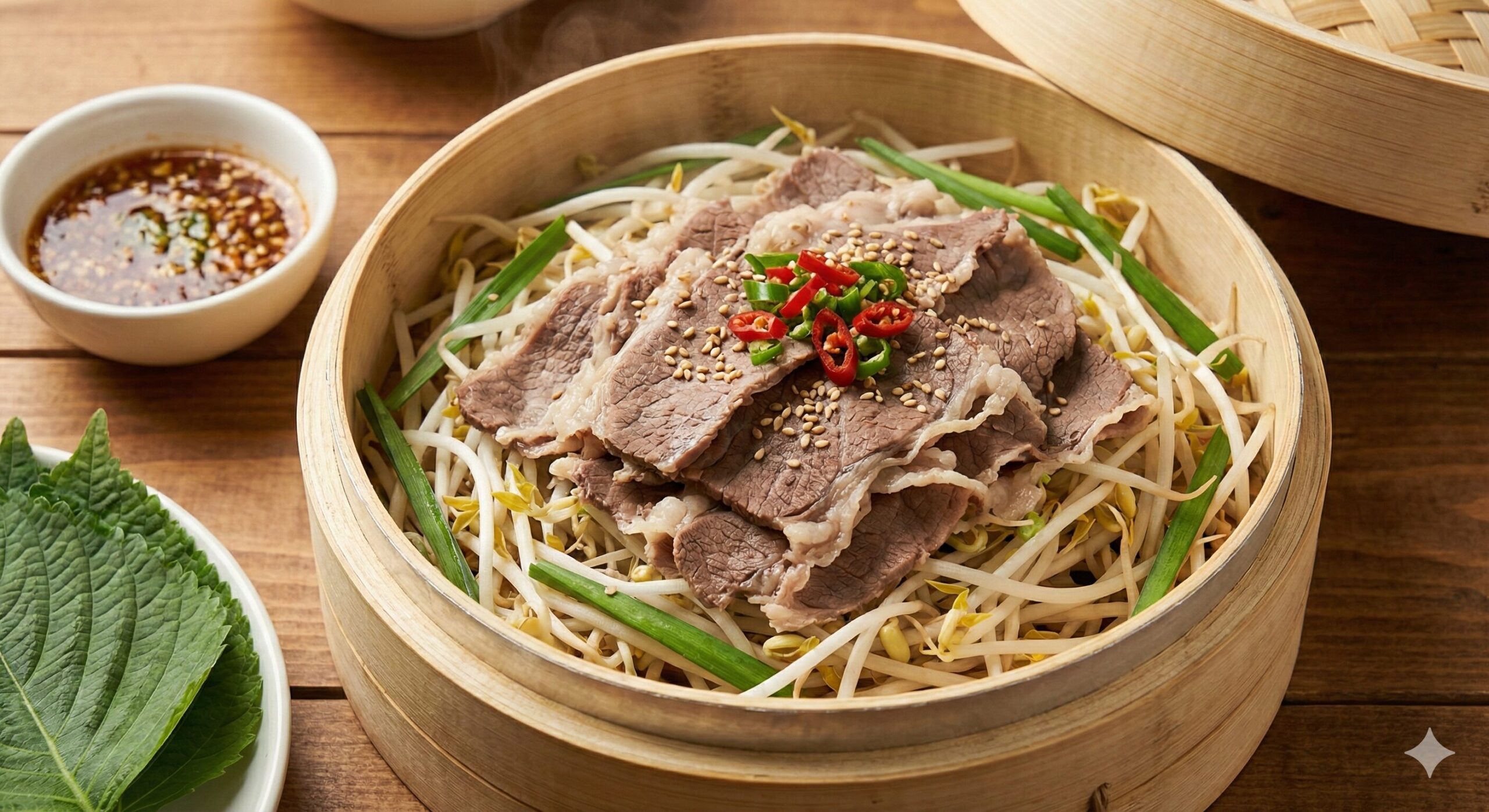
- Menu: Korean Steamed Beef & Bean Sprouts (Recipe Link)
- The Logic (Why Steaming Matters):
- Zinc (The Gatekeeper): According to research in Nutrients, Zinc is the critical mineral that regulates the expression of Claudin and Occludin, the proteins that form Tight Junctions. Beef is the most bioavailable source of Zinc. A deficiency directly correlates with increased gut permeability.
- Low AGEs (No Maillard Reaction): Grilling meat creates the “Maillard Reaction,” which tastes good but produces Advanced Glycation End-products (AGEs). AGEs are inflammatory compounds that bind to RAGE receptors, triggering oxidative stress. By Steaming the beef, we keep the temperature around 100°C, preventing AGE formation and preserving the structural integrity of the proteins. This is the ultimate “clean” protein for gut repair.
1.6. Daily Macro & Calorie Breakdown
- Morning: ~270 kcal
- Lunch: ~320 kcal (Volume-rich, nutrient-dense)
- Snack: ~150 kcal
- Dinner: ~400 kcal (High Protein, Zero AGEs)
👉 Total: ~1,140 kcal (Note: Today’s menu is designed to minimize the digestive workload while maximizing the delivery of repair materials.)
[Challenge Navigation]
- 📍 The Big Picture: View the 100-Day Transformation Roadmap
- 🔙 Previous Step (Day 2): The Anti-Inflammatory Shield: Lycopene & Omega-3
- 👉 Next Step (Day 4): The Bioavailability Protocol: Curcumin Synergy & Satiety
[Day 3] 장벽 재건 프로토콜: 아연(Zinc)과 저당독소(Low AGEs)로 ‘장 누수’를 봉인하라
2.1. 3일 차의 과학: 무너진 장벽, 왜 ‘재건’이 필요한가?
100일 챌린지의 3일 차는 **’구조적 재건(Structural Reconstruction)’**의 날입니다. 원인 모를 만성 피로, 브레인 포그, 알러지 반응의 80% 이상은 **’장 누수 증후군(Leaky Gut Syndrome)’**에서 기인합니다. 장 내벽을 덮고 있는 세포들은 **’치밀 결합(Tight Junctions)’**이라는 단백질 사슬로 단단히 묶여 있어야 합니다. 하지만 스트레스나 염증성 음식으로 인해 이 결합이 느슨해지면, 거르지 못한 독소(LPS)가 혈관으로 침투하여 전신 염증을 유발합니다. 이를 수리하기 위해서는 치밀 결합을 파괴하는 **조눌린(Zonulin)**을 억제하고, 결합을 조여주는 **아연(Zinc)**을 공급해야 합니다. 또한, 조직을 딱딱하게 만드는 당독소(AGEs) 섭취를 철저히 차단해야 합니다.
2.2. 모닝 루틴: 점막 보호를 위한 기초 공사
- 따뜻한 물 + 핑크솔트: 점막의 삼투압 밸런스를 유지하고 수분을 공급합니다.
- 올리브 오일 반 샷: 소화관 내벽을 윤활하게 코팅(Lubrication)하고, 담즙 배출을 유도하여 간 해독을 돕습니다.
- 삶은 계란 2알: 장세포(Enterocytes)가 가장 좋아하는, 그리고 유일한 에너지원인 **글루타민(Glutamine)**을 공급합니다. 단백질 없이는 장벽의 물리적 복구가 불가능합니다.
2.3. 점심: 파라바이오틱스(Paraprobiotics)의 면역 혁명
- 메뉴: 콩나물 김치죽 (레시피 보기)
- 의학적 근거 (죽은 유산균이 더 강력한 이유): 많은 사람들이 유산균은 살아서 장까지 가야 한다고 믿습니다. 하지만 면역학 저널(Frontiers in Immunology, 2020) 등의 최신 연구는 **’파라바이오틱스(가열 처리된 사균체)’**의 효능에 주목합니다.
- 세포벽 성분(Peptidoglycans): 김치를 끓이면 유산균은 죽지만, 그 세포벽 성분은 그대로 남아 장내 면역 수용체(TLR)를 자극합니다. 이는 가스나 복부 팽만(SIBO) 부작용 없이 면역력을 안전하게 부스팅합니다.
- 아스파라긴산: 콩나물의 아스파라긴산은 간의 요소 회로(Urea Cycle)를 가속화하여, 체내 독소인 암모니아를 빠르게 배출합니다.
2.4. 간식: 프리바이오틱스 (장내 미생물 먹이)
- 메뉴: 그레인 프리 그래놀라 (레시피 보기)
- 의학적 근거: 장 누수의 주범인 **글루텐(Gluten)**을 배제합니다. 대신 견과류의 발효성 식이섬유를 섭취하여, 장 점막을 두껍게 만드는 유익균(Akkermansia muciniphila)에게 먹이(Prebiotics)를 제공합니다.
2.5. 저녁: 아연(Zinc) 공급과 마이야르 반응 차단
- 메뉴: 소고기 숙주찜 (레시피 보기)
- 의학적 근거 (왜 구우면 안 되는가?):
- 아연 (치밀 결합의 문지기): 국제 학술지 Nutrients는 아연(Zinc) 결핍이 장 투과성을 증가시키는 직접적인 원인임을 명시했습니다. 소고기는 아연 생체 이용률이 가장 높은 식품으로, 느슨해진 클라우딘(Claudin) 단백질 결합을 다시 조여줍니다.
- 저당독소 (Low AGEs): 고기를 직화로 구울 때 갈색으로 변하는 **’마이야르 반응’**은 맛은 좋지만, 염증성 독소인 **최종당화산물(AGEs)**을 폭발적으로 생성합니다. AGEs는 세포의 수용체(RAGE)와 결합하여 산화 스트레스를 유발합니다. 100°C 이하의 증기로 ‘찌는(Steaming)’ 조리법은 단백질 변성을 막고 당독소 생성을 억제하는 가장 깨끗한 바이오해킹 조리법입니다.
2.6. 일일 매크로 & 칼로리 분석
- 아침: ~270 kcal
- 점심: ~320 kcal (소화 부담 최소화, 면역 최대화)
- 간식: ~150 kcal
- 저녁: ~400 kcal (고단백, 고아연, 저당독소)
👉 일일 총 섭취량: 약 1,140 kcal (참고: 오늘은 소화 기관의 염증 불씨를 끄고, 무너진 성벽을 다시 쌓는 재건의 날입니다.)
[100일 챌린지 내비게이션]
- 📍 전체 로드맵: K-바이오해킹 100일 변화의 여정 보기
- 🔙 이전 단계 (Day 2): 항염증 방패: 라이코펜과 오메가-3의 지질학
- 👉 다음 단계 (Day 4): 생체이용률의 과학: 커큐민 시너지와 건강한 포만감